Pillow Guide · Sleep Science
What Down Pillow Fill Power Can—and Can’t—Tell You
A fill-power number describes the loftiness of down, not the whole experience of resting your head on it. To understand how a pillow may feel, consider the rating alongside its fill amount, chamber construction, shape, and the way you sleep.
A pillow arrives with an invitation to judge it quickly. Press a palm into the surface; watch the indentation gather itself back. Fold a corner, perhaps, or lift the pillow by one edge. It seems a simple object, until the labels begin: down, feather, fill power, chamber, firmness. One number, in particular, tends to suggest that the pillow has already answered the important questions. It has not.
Fill power is a measure of the space occupied by a given weight of down under specified testing conditions. A higher rating generally indicates down with greater loft: the clusters take up more volume for their weight. That can be useful information when comparing materials. But a pillow is not a jar of loose down, and the number does not directly tell you whether the finished pillow will feel firm, soft, high, flat, or right for your neck.
Those qualities emerge from the arrangement of materials and the sleeper’s own preferences. How much filling is inside? Is the pillow one open chamber or several? Does it contain down alone, or a blend? How much does it compress beneath the head? Is the sleeper on their side, back, or stomach? Fill power belongs in the conversation. It simply should not be allowed to conduct it.
The meaning behind the number
Down consists of the soft clusters found beneath the outer feathers of waterfowl. Unlike a feather, which has a central shaft, a down cluster is made up of fine filaments spreading outward from a small center. Those filaments can trap air. When a quantity of down is allowed to loft under a defined test, the volume it occupies can be measured. Fill power expresses that volume in cubic inches per ounce.
In broad terms, higher fill power means that an ounce of down expands to occupy more space than an ounce with a lower rating. The distinction is about loft per unit of weight, not a direct measurement of a pillow’s firmness or its height once someone is lying on it. Test methods and conditions matter, too; ratings are useful only when they are obtained and reported consistently. A number on a label is a specification, not a complete account of how a pillow behaves.
It is tempting to translate “more volume” into “more support.” The leap is understandable, and often misleading. A lofty filling can help a pillow retain a plump appearance, but support depends on what happens when the head and neck place weight on it. Down compresses. The degree of compression depends on the amount and type of fill, the pillow’s construction, and the pressure applied. A pillow that looks full on the bed may settle substantially beneath a sleeper.
Fill power can therefore suggest something about the character of the down itself. It cannot, by itself, tell you what the pillow will do under your particular head.
Loft is not firmness
Loft and firmness are sometimes treated as if they were two names for the same quality. They are not. Loft describes height or fullness; firmness describes resistance to compression, as experienced by the person using the pillow. A pillow may be lofty when fluffed and yielding once it is occupied. Another may have a lower profile yet feel comparatively resistant, depending on its materials and structure.
Consider the difference between an empty coat and a coat worn outdoors. Its appearance tells you something about its insulation and shape. It does not tell you exactly how it will settle across your shoulders. A down pillow behaves in its own less dramatic way. Its visible loft is a starting point. The sleeper’s weight, habitual position, and movement during the night change the picture.
A high fill-power down can be light and expansive, but a pillow made with a modest quantity of it may still feel less substantial than one containing more fill of a lower rating. Conversely, a pillow packed with a larger quantity may feel fuller or more resistant, though the material’s precise behavior will depend on its design. The rating describes the down per ounce; it does not tell you how many ounces the manufacturer placed in the pillow.
That missing detail matters. Two pillows with identical fill power can feel notably different if one contains more filling, has a different outer fabric, or is divided into chambers. The rating is a clue about one ingredient, not a verdict on the finished object.
Fill amount changes the experience
When comparing down pillows, ask how fill power works together with the amount of fill. A pillow’s total weight, when available, can provide context, though it is not a comfort score either. More fill may create a fuller shape and can affect how much the pillow gives under pressure. Yet the same amount of filling can feel different in different constructions, and the word “supportive” may mean different things to a back sleeper and a side sleeper.
For a side sleeper, the pillow must accommodate the space between the head and the mattress while helping the neck remain comfortably aligned. A very compressible pillow may not maintain enough height for that person, though a different fill amount or construction could alter the result. Back sleepers often prefer a profile that fills the space beneath the head without pushing it sharply forward. Stomach sleepers commonly look for a lower, more yielding surface. These are broad preferences, not rules: mattress firmness, shoulder width, body shape, and individual comfort all play a part.
This is why a fill-power comparison should not be mistaken for a position-specific recommendation. A rating does not know where you sleep, how far your shoulder sinks into the mattress, or whether you like to fold a pillow into a small crescent at three in the morning.
Construction is part of the answer
The shell and internal structure help determine how a down pillow holds its shape and distributes its contents. A single chamber allows the filling to shift more freely. Multi-chamber designs separate materials or arrange them in layers, which can create distinct sensations across the surface and center. A firmer core, for example, may provide a different response from soft outer chambers. These design choices can affect the feel of the complete pillow even when a fill-power figure for the down is known.
Blends add another consideration. “Down pillow” does not always mean that every part of the fill is down. A product may combine down with feathers or other materials, or use different fills in different chambers. Feather content can alter weight and feel; a core made from another material may contribute structure. Read the material description closely, and look for the amount or proportion of each component when the manufacturer provides it. A rating for down should not be assumed to describe every part of a mixed fill.
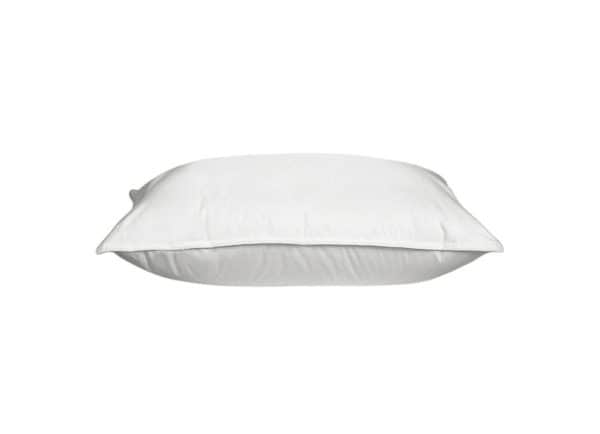
The DownTown Company Interior Balance Pillow offers an example of why construction matters. Its stated design pairs outer chambers filled with 90% European white down with a supportive inner core described as 20% European white down. The product information emphasizes a dual-core structure and a soft feel with gentle support; it does not provide a fill-power rating. The useful point is not to infer a number that is absent, but to notice that the arrangement of the chambers is part of the pillow’s character.
A construction description can tell you things a single fill-power figure cannot: whether the pillow has a distinct center, whether materials are layered or separated, and what sort of overall feel the maker intends. Those claims still do not guarantee that the pillow will suit every sleeper. They do, however, help you ask more relevant questions.
A rating is not a complete quality grade
Higher fill power is often presented as a mark of superiority. It may indicate loftier down under the relevant test, but it should not be read as a universal ranking of comfort, durability, sourcing, or suitability. The pillow is a finished product made from materials assembled in a particular way. A lofty down cluster cannot, on its own, guarantee sound stitching, a comfortable shell, a useful profile, or a good match for a particular sleeper.
Nor does the number tell you everything about the sourcing or processing of the fill. Those are separate questions, answered by clear product disclosures and credible standards where applicable. Shoppers who care about origin, animal-welfare practices, or certifications should look for those details independently rather than expecting fill power to stand in for them.
There is also the small problem of comparison. Labels may omit test details, and ratings are not always presented with enough information to know whether two products have been evaluated under comparable conditions. A difference in numbers can be meaningful, but the number alone does not establish how noticeable that difference will be in a finished pillow. Treat precise claims with the same sensible curiosity you would bring to any specification: ask what was measured, and what was left out.
How to compare pillows more thoughtfully
Start with your experience rather than with the most impressive-looking figure. Have your current pillows felt too high, too flat, too warm, or too prone to losing their shape? Do you sleep mostly on your side, back, or stomach? Does the pillow need to accommodate a particular sleeping arrangement or personal comfort preference? These observations narrow the field in a way that a rating cannot.
- Check the fill composition. Find out whether the pillow contains down alone or a blend, and whether different materials occupy separate chambers.
- Look for fill amount or pillow weight. If provided, these details add context to fill power. Neither is a stand-alone measure of comfort, but they help describe what is inside.
- Read the construction description. Note whether the pillow is one chamber, layered, or built with an inner core. Construction may help explain how it feels under pressure.
- Consider your sleeping position. Think about the profile and level of give you find comfortable, while remembering that body shape and mattress feel also matter.
- Look for practical details. Dimensions, care instructions, the shell material, return terms, and warranty information can be more useful to everyday ownership than a rating alone.
- Try it if you can. When possible, assess a pillow in a way that resembles how you actually sleep. A quick squeeze in a shop can reveal something, but it cannot reproduce a full night.
When two pillows share a fill-power rating, compare the rest of their specifications. When their ratings differ, resist the urge to declare the higher one the winner before considering fill quantity and design. The practical question is not which pillow contains the loftiest down in isolation. It is which completed pillow offers a comfortable and sustainable feel for you.
The quiet importance of personal preference
Pillow comfort is intimate in a way product language can find awkward. One sleeper wants a soft surface that yields immediately. Another wants the reassuring sensation of a pillow that keeps some shape. A person may prefer a low, pliable pillow on one mattress and a fuller one on another. Even the same sleeper may revise their preferences over time, after a change in habits, bedding, or what feels comfortable to them.
There is no reliable conversion table that turns fill power into a universal firmness rating. Nor is there a number that can tell you exactly how a pillow will feel after the first hour, when the down has settled and your head has found its customary place. Testing and a clear understanding of product details remain more useful than a promise that a single figure can settle the matter.
That does not make fill power meaningless. It can help distinguish down with more or less loft per ounce and can form one part of an informed comparison. The mistake is not paying attention to the rating; it is asking it to answer questions it was never designed to answer.
The short version
Fill power describes the volume occupied by a given weight of down under specified conditions. Higher fill power generally indicates loftier down, but it does not automatically mean that a pillow will be firmer, more supportive, or more comfortable. The finished feel also depends on fill quantity, chamber design, materials, shell, and how the pillow compresses beneath a particular sleeper.
So read the number, then keep reading. Look at the composition and construction. Consider your sleeping position and the shape you find comfortable. If a product provides only a fill-power rating, you have learned something about its down—but not yet enough to know how it will feel beneath your head. A pillow, after all, is less a number than an arrangement of materials encountered in the dark, when the day’s judgments have finally been set aside.